The most common question I get about this site is some version of: you're not an attorney, so why are you building tools for attorneys?
It is a fair question. I am not licensed to practice law. I have never taken a bar exam. I have no stake in the outcome of any case. So what I am doing here requires some explanation.
What I actually am
I build software. Specifically, I build AI tools that help people do knowledge work faster and with fewer gaps. Before I started focusing on legal workflows, I worked on similar problems in other fields where skilled professionals were doing high-value work but spending a lot of time on information tasks that did not require their expertise.
The pattern shows up everywhere: a professional with real training spends the first hour of their day on data entry, email drafts, and chasing down information that should already be organized. The thing they are actually good at, the reason they got licensed or credentialed or hired, gets squeezed into the remaining hours.
When I looked at legal practice, especially solo and small firm practice, the same pattern was obvious.
What I actually saw
The bottleneck in a high-volume PI practice is not legal skill. Most solo attorneys who do personal injury work have the legal knowledge to handle far more cases than they currently do. The bottleneck is time, and the time gets eaten by tasks that are not really legal work.
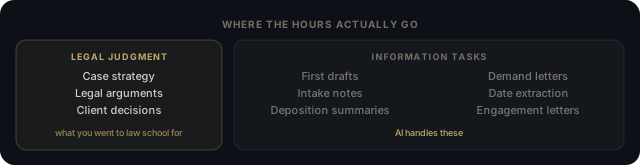
Writing the first draft of a demand letter from scratch. Pulling dates and facts out of intake notes so a file is complete before it opens. Summarizing a deposition transcript into something you can actually use in preparation. None of those tasks require a law degree. They require time and attention, and they eat both.
AI is useful precisely here. Not because it practices law, but because it handles the information assembly part of the workflow. The attorney still reads the output, edits it, makes the legal judgments, and signs off. But they are starting from a structured draft instead of a blank page, and that difference compounds across a hundred cases a year.
Why I made them free
I am building toward a paid product for law firm practice management. The free tools on this site are part of that, but they are also useful on their own.
My reasoning was straightforward: if I build something genuinely useful and give it away, attorneys will use it. If they use it and it works, some of them will want more. That is the business model, but it is also the honest version of why the tools are free. They are free because they should be free. A solo attorney with forty active cases should not have to pay forty dollars a month to draft faster.
What these tools are not
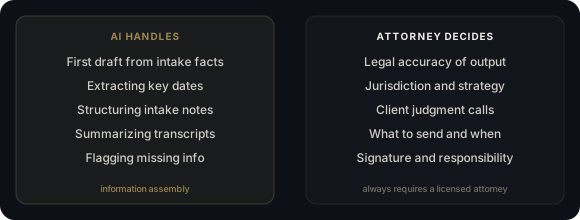
They are not legal advice. They do not know your jurisdiction, your judge, or your client. They do not know whether the liability assessment is right or whether the medical specials are accurate. They produce a starting point that a licensed attorney reviews, edits, and takes responsibility for.
I am careful about this because I think some AI legal tools are not careful about it. There is a version of this space where someone builds a tool, calls it a "legal AI assistant," and lets users believe the output is more reliable than it is. That is not what I am doing, and I try to make that clear in how every tool on this site is framed.
The output is useful. It is not finished. Those are different things.
Where this is going
I am adding tools when I see a workflow where AI clearly helps and where the tool can be built well enough to be worth using. The intake pipeline, the demand letter generator, the deposition summarizer. Each one targets a specific task that attorneys do repeatedly and that does not require legal judgment to complete.
The goal is not to replace any part of legal practice. It is to give solo and small firm attorneys the same leverage that large firms get from having support staff, without the overhead of actually hiring support staff.
I do not think you need to be an attorney to see that problem clearly. You just need to have talked to enough attorneys who are working through lunch to fix drafts they should not have had to write in the first place.
If you want to try any of the tools, everything on this site is free with no account required. The intake pipeline is a good place to start if you handle PI cases.